
Beginning January 1, 2027, adults ages 19 to 64 covered through Medicaid expansion must complete 80 hours a month of work, education, training, or community service, or qualify for an exemption, to keep their coverage (CMS, 2026). Starting with renewals due December 31, 2026, the same population will be redetermined every six months instead of annually. CMS projects the work requirement alone will cut Medicaid enrollment by 2.3 million people in fiscal year 2027.
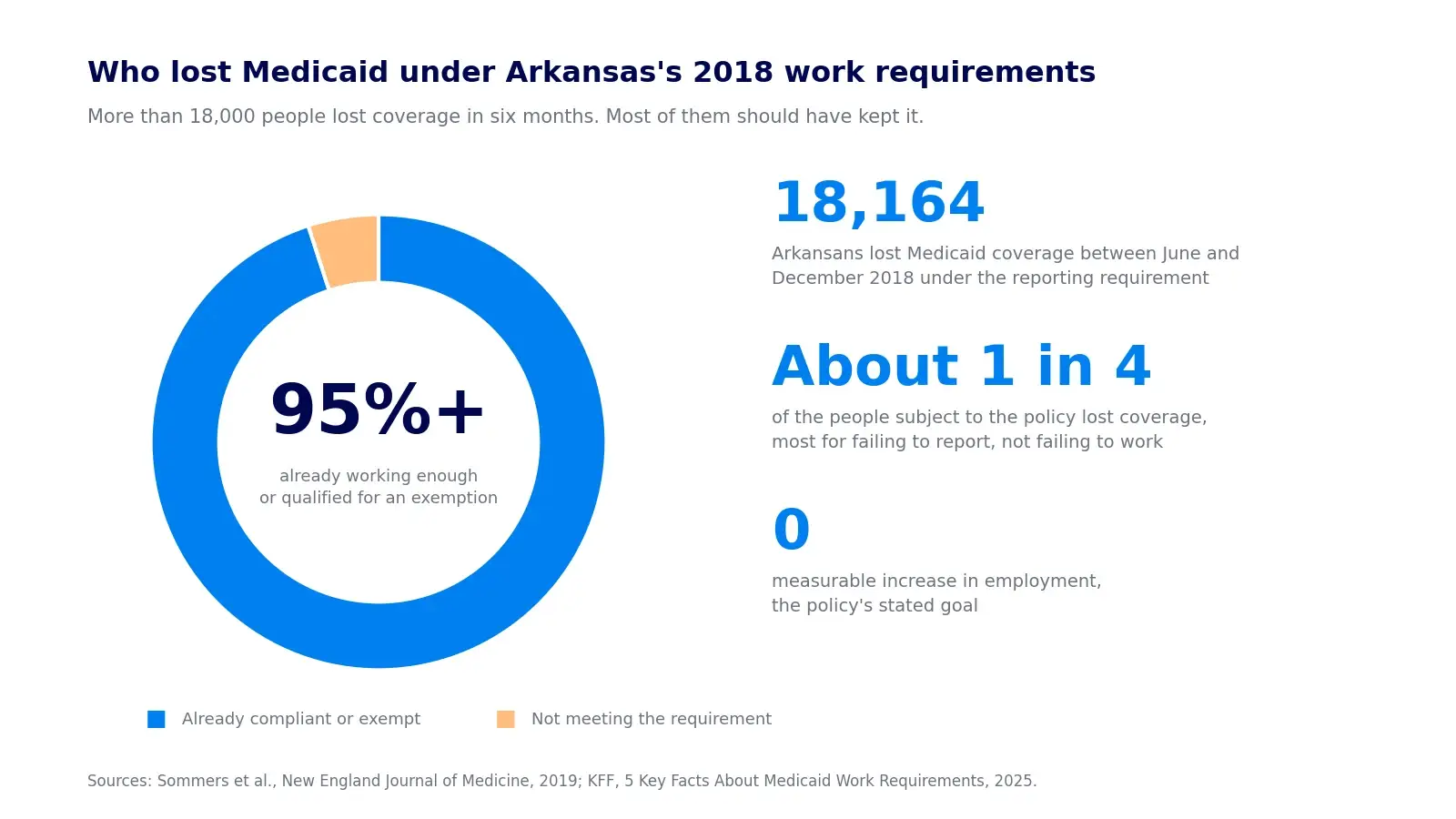
The lesson from the only state that has enforced a requirement like this is sobering. When Arkansas implemented Medicaid work and reporting requirements in 2018, more than 18,000 people lost coverage within six months, even though more than 95% of those subject to the policy were already working enough hours or should have qualified for an exemption (New England Journal of Medicine, 2019). People lost coverage because they didn’t know about the rule or couldn’t figure out how to report.
For Rural Health Clinics (RHCs) and Federally Qualified Health Centers (FQHCs), that is the real risk: eligible patients losing Medicaid over paperwork, arriving uninsured, and covered visits turning into self-pay. Preventing it takes outreach at a scale no front desk can deliver by phone.
Key Takeaways
- Medicaid community engagement requirements take effect by January 1, 2027 in the 43 states plus DC that cover expansion adults, with some states starting earlier.
- In Arkansas, more than 95% of people who lost coverage under a similar rule were already compliant or exempt. Awareness and paperwork, not eligibility, drove the losses.
- RHCs and FQHCs can use automated text and voice AI conversations to educate patients, surface those who may need help, send deadline reminders, and route complex cases to staff.
- HealthTalk A.I. does not determine Medicaid eligibility or exemptions. It works as the engagement and navigation layer between the clinic and its Medicaid population.
What Do the New Medicaid Community Engagement Requirements Mean for Clinics?
They create a new administrative burden for patients and a new coverage risk for the clinics that serve them. Under the CMS interim final rule issued June 1, 2026, affected adults must show 80 hours a month of qualifying activity, or earnings of at least 80 times the federal minimum wage ($580 a month in 2026), verified at application, at renewal, and at state option more often. States must implement by January 1, 2027; Nebraska began on May 1, 2026 (CMS, 2026).
Exemptions cover people who are pregnant or postpartum, medically frail or disabled, caretakers of children under 14, and several other groups. In 2027 patients may attest to an exemption; documentation is required beginning in 2028, and CMS now defines medically frail more narrowly, requiring a condition that significantly impairs the ability to comply.
Layer on six-month redeterminations and patients face more notices, more deadlines, and more chances to fall through the cracks. Clinics feel it as coverage churn, uncovered visits, and billing delays, the same pattern we saw during the unwinding of continuous Medicaid enrollment.
Why Won’t Manual Outreach Keep Up?
Manual outreach fails on volume, not effort. Calling every Medicaid patient, leaving voicemails, repeating the same explanation, tracking responses, and deciding who needs follow-up is a full-time job for several people at a clinic that is already short-staffed. Most calls go to voicemail, and the patients who most need help are the hardest to reach during business hours.
Arkansas showed what happens when education depends on letters and portals: people who qualified never heard, or heard and got lost. The clinic is the one institution many of these patients already trust and already text with. Automation is what lets you use that relationship at population scale without adding to front desk burnout.
How Does AI-Assisted Medicaid Outreach Work?
The clinic identifies the population that needs outreach and HealthTalk A.I. operationalizes the engagement through a repeatable pathway:
Identify → Outreach → Educate → Assess → Remind → Escalate → Connect
Patients are engaged by two-way text or AI voice conversation, in their preferred language, on their own schedule. The platform runs targeted population campaigns, tracks every response, and escalates to staff when a human is needed, using the same patient communication capabilities health centers already use for care gap outreach and scheduling.
One boundary matters. The AI does not determine Medicaid eligibility, decide that a patient is medically frail, or replace state processes. It is an intelligent front door: patient response, potential need identified, appropriate staff workflow triggered.
Seven Medicaid Engagement Use Cases for RHCs and FQHCs
1. Proactive population outreach
Identify the Medicaid patients likely to be affected and reach all of them at once with messages that explain what is changing, reinforce deadlines, deliver state-approved educational content, and point patients to the right resources.
2. Interactive education and navigation
Instead of a one-way notice, the conversation asks: Are you aware of the new Medicaid requirements? Do they apply to you? Do you think you may qualify for an exemption? Do you need help with documentation? Would you like someone from the clinic to contact you? Each answer moves the patient down a navigation path.
3. Exemption and medically frail support
Some patients will need provider-supported documentation for a medically frail exemption. The AI flags patients who report circumstances that may warrant review and routes them to designated clinical or eligibility staff, so professionals review the patients who need it rather than screening the entire panel by hand.
4. Documentation and deadline reminders
Administrative complexity is as much a threat to coverage as the requirement itself. Automated sequences carry patients from initial education to reminder, approaching deadline, final reminder, and staff escalation. Patients who complete the step exit the pathway; the rest are prioritized for intervention, following the same multi-touch cadence principles that reduce missed visits.
5. Renewal and eligibility engagement
With expansion adults renewing every six months, the same infrastructure reminds patients about upcoming renewals, nudges them to respond to agency notices, and connects those who need help with enrollment or financial counseling. The objective is simple: find patients at risk of preventable coverage loss before they become uninsured or self-pay.
6. Multimodal and multilingual engagement
Vulnerable populations rarely respond to another letter. Text and AI voice conversations with multilingual support let patients engage when it suits them, without a patient and a clinic employee needing to be free for the same call.
7. Intelligent staff escalation
Automation makes the human role more targeted, not smaller. Routine education, reminders, and basic questions run automatically; confusion, a possible exemption, a documentation need, or a request for help routes to the right staff workflow. Instead of asking “Who do we need to call?”, staff can ask “Who needs us right now?”
Traditional Outreach vs. AI-Assisted Engagement
| Traditional approach | AI-assisted approach |
|---|---|
| Staff manually work patient lists | Target populations receive automated outreach |
| Repeated outbound phone calls | Two-way text plus AI voice engagement |
| Staff repeat the same education | Standardized, multilingual educational conversations |
| Patients call the clinic with basic questions | AI handles routine navigation and FAQs |
| Staff manually identify potential issues | Patient responses flag intervention needs |
| Manual reminder calls | Automated multi-touch reminder sequences |
| Outreach limited by staff capacity | Population-scale engagement |
| Staff spend time finding who needs help | Staff focus on patients who need human intervention |
Why This Matters for RHCs and FQHCs
The Medicaid changes are a patient access problem and a financial problem at once. A patient who stays eligible but loses coverage over a missed notice or missing documentation becomes uninsured or self-pay. Multiply that across a Medicaid-heavy panel and it lands on the bottom line, on top of the pressures health centers are already managing in 2026.
A scalable coverage retention strategy lets AI handle the high-volume communication while staff capacity is preserved for the situations that require human judgment. The opportunity is not simply to notify patients that Medicaid is changing. It is to build an engagement infrastructure that finds the right patients, starts the conversation, identifies barriers, keeps patients moving through required steps, and brings staff in exactly when they are needed.
Start the Conversation Before the Deadline
The clinics that protect coverage in 2027 will be the ones that started talking to their Medicaid patients in 2026.
See how HealthTalk A.I. helps RHCs and FQHCs run Medicaid outreach, education, and renewal reminders by text and voice AI across the entire patient population.
Request a Demo