
The Medicare annual wellness visit is the rare service that costs the patient nothing, pays the practice, and closes care gaps in a single appointment. It’s also chronically underused: claims data shows only about 39% of Medicare beneficiaries received an AWV in a given year (JAMA Health Forum, 2026). With the fourth quarter here, every eligible patient still unscheduled is a quality measure, a risk score, and a reimbursement that slips into next year. Here is the playbook for filling the schedule before December 31.
Key Takeaways
- Roughly six in ten Medicare beneficiaries skip the AWV each year, even though it carries no copay or deductible when billed alone.
- Eligibility runs on a month-based clock: a patient seen in March 2025 became eligible again on March 1, 2026, so the overdue list is bigger than most practices think.
- Year-end AWVs feed HEDIS and Star measures, value-based contract performance, and the screenings that fill next year’s schedule.
- Allegiance Healthcare scheduled 1,768 visits in six weeks with automated AWV outreach and AI scheduling, without adding staff.
What Is a Medicare Annual Wellness Visit?
A Medicare annual wellness visit is a yearly preventive planning visit covered under Part B. It is not a physical exam. The visit centers on a health risk assessment and a personalized prevention plan, not a head-to-toe examination.
Three codes cover the timeline: G0402 for the Welcome to Medicare visit in the first 12 months of Part B, G0438 for the first AWV after that (once per lifetime), and G0439 for every subsequent AWV. FQHCs bill the service under G0468. The initial visit pays more than the subsequent one, and Medicare Advantage plans cover the AWV as well. Patients pay nothing when the AWV is billed alone.
Why Does the AWV Matter So Much Before Year-End?
The AWV matters before year-end because quality measures, risk documentation, and next year’s revenue converge in one visit. Each completed AWV updates the patient’s risk factors, orders the screenings that count toward HEDIS and Star measures, and produces the written screening schedule that fills January. Practices in value-based contracts feel this most, since the AWV is often the one appointment where several care gaps get identified and closed at once. For health centers, those measures double as a funding defense strategy.
Then there’s the eligibility clock. Medicare requires at least 11 full months to pass after the last AWV, so a patient seen on March 10, 2025 became eligible on March 1, 2026. Anyone without an AWV since this time last year is already eligible. Add the patients who have never had one, and the list is usually far larger than the schedule reflects.
The Annual Wellness Visit Checklist: What the Visit Must Include
CMS defines the required components, and a documented checklist keeps the claim clean, since documentation gaps are a common source of AWV denials. A subsequent AWV (G0439) must include:
- An updated health risk assessment (HRA), ideally completed by the patient before the visit
- Updated medical and family history, and a current list of providers and suppliers
- Weight, blood pressure, and other routine measurements
- Detection of cognitive impairment through direct observation or a structured tool
- An updated list of risk factors and conditions, with interventions recommended or underway
- An updated written screening schedule for the next five to ten years
- Personalized health advice and referrals, such as fall prevention, nutrition counseling, or tobacco cessation
The initial AWV (G0438) adds a review of depression risk and of functional ability and safety. Advance care planning can be added, and add-on codes change most years, so confirm them each January. One practical tip: send the HRA and screeners by text before the visit. Practices using digital intake with clinical screeners delivered before the visit walk into the room with the risk assessment done, which shortens the visit and tightens documentation.
How Do You Fill the AWV Schedule in the Next 90 Days?
Pull the eligible list, segment it, and automate outreach and booking so staff aren’t dialing two thousand patients by hand. Six steps:
- Build the list. Query every Part B patient and Medicare Advantage member with no AWV in the past 11 full months, plus everyone who has never had one, with preferred language and mobile number.
- Prioritize. Never-had patients first (G0438 pays more), then longest overdue, then open care gaps.
- Text, don’t call. Send a two-way message in the patient’s language: “Hi [Name], you’re due for your yearly Medicare wellness visit with Dr. [Name]. It’s covered at no cost to you. Would you like to book a quick visit now? Reply with any questions.” Follow up at five to seven days, then send one final touch before year-end. AI patient scheduling offers real-time availability right in the conversation and writes the booking to the EHR.
- Prepare the visit. Deliver the HRA and screeners by text a few days ahead.
- Protect the appointment. Remind at three days and 24 hours with the option to reschedule right in the reply, following the evidence-based cadence that cuts no-shows.
- Measure weekly. Eligible, contacted, booked, completed, and the measures closed per visit.
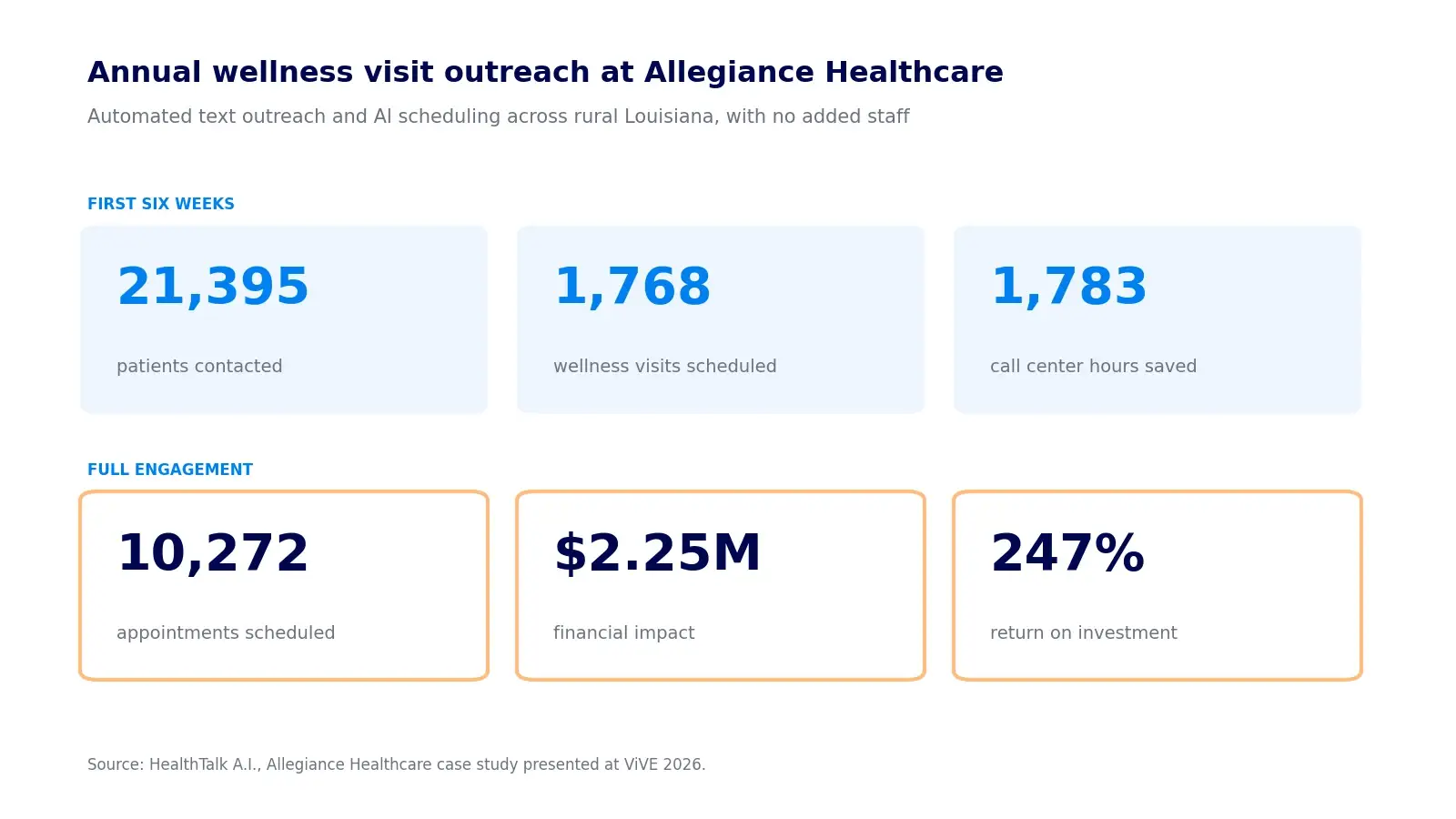
Allegiance Healthcare ran this play across rural Louisiana. Using HealthTalk A.I. for wellness visit outreach and scheduling, Allegiance contacted 21,395 patients, scheduled 1,768 visits, and saved 1,783 call center hours in the first six weeks. Over the full engagement it scheduled 10,272 appointments and produced $2.25 million in financial impact, a 247% ROI, without adding headcount.
Turn Year-End Pressure Into a Full Schedule
The patients are already eligible and the reimbursement is already covered. What most practices lack is a way to reach thousands of them at once and let each one book in seconds. See what your unscheduled AWVs are worth with the HealthTalk A.I. ROI calculator.
See how automated outreach and AI scheduling fill the fourth quarter.
Request a Demo