
A good patient payment reminder text does four things: it says who it’s from, tells the patient a balance is ready, gives a secure way to pay, and offers a way to get help or set up a plan. It leaves out the service, diagnosis, procedure and anything else clinical, because anyone who glances at a lock screen can read it. Below are 12 payment reminder templates for every stage of the billing cycle, plus the cadence and safeguards that make text to pay work.
Key Takeaways
- A good payment reminder text says who it is from, that a balance is ready, how to pay securely and how to get help, and leaves out the service, diagnosis or procedure.
- Send reminders on a steady cadence from statement day to 30 days past due, and stop the sequence the moment a payment posts.
- In Experian Health’s 2026 survey, 41% of patients whose payment experience improved said payment plan options helped, so offer a plan in your first text.
What a Patient Payment Reminder Should and Shouldn’t Say
Every text needs:
- Who it’s from. Lead with your practice name so the patient doesn’t mistake you for a scam. If your name reveals a sensitive specialty, consider a neutral billing name patients will recognize from their statement.
- That a balance is ready. The amount and due date are enough.
- How to pay securely. A link to a secure, PCI compliant payment page.
- How to get help. A phone number, a payment plan option, or a reply keyword that reaches a person.
Leave out:
- The service, diagnosis, procedure, test or provider specialty
- Insurance claim details or denial reasons
- Anything a family member shouldn’t learn from a shared phone
12 Payment Reminder Templates for Every Stage
Copy these and swap in your details. Every payment text uses a [secure payment link] placeholder for your text to pay link.
When a New Statement Is Ready
1. Statement ready
Hi [First Name], this is [Practice Name]. Your new statement is ready. Balance: [Amount], due [Due Date]. Pay securely here: [secure payment link]. We will never ask for your card number by text. Questions? Call [Phone]. Reply STOP to opt out.
2. Statement ready, with a plan option
Hi [First Name], [Practice Name] here. Your statement for [Amount] is ready. Pay in full or set up monthly payments at [secure payment link]. Reply PLAN for payment plan options or CALL for a call back.
When the Due Date Is Close
3. A few days before the due date
Hi [First Name], a friendly reminder from [Practice Name]: your balance of [Amount] is due [Due Date]. Pay securely here: [secure payment link]. Need more time? Reply PLAN.
4. Due today
Hi [First Name], your [Practice Name] balance of [Amount] is due today. Pay here: [secure payment link]. Already paid? Thank you, and please ignore this message.
When a Balance Is Past Due
5. Gentle first notice
Hi [First Name], this is [Practice Name]. We haven’t received payment for your balance of [Amount], which was due [Due Date]. Life gets busy, so here’s the link: [secure payment link]. Reply CALL if you’d like help.
6. Second notice, still friendly
Hi [First Name], [Practice Name] following up on your past due balance of [Amount]. If cost is a concern, we can split it into monthly payments. Reply PLAN for options, CALL for a call back, or pay here: [secure payment link].
7. Firmer notice at 30 days
[First Name], this is the [Practice Name] billing office. Your balance of [Amount] is now more than 30 days past due. Please pay by [Due Date] at [secure payment link] or call [Phone] to set up a plan. We want to resolve this with you directly.
Keep firm notices factual, and never hint at action you won’t take.
Payment Plans
8. Payment plan offer
Hi [First Name], [Practice Name] here. Your balance of [Amount] can be paid over time with a monthly plan. Set it up securely here: [secure payment link], or reply CALL and our billing team will help.
9. Installment reminder
Hi [First Name], your next [Practice Name] payment plan installment of [Amount] is due [Due Date]. Pay or review your plan here: [secure payment link]. Reply CALL if you need to adjust it.
Before the Visit
10. Pre visit estimate
Hi [First Name], this is [Practice Name]. Ahead of your visit on [Date], your estimated amount due is [Amount]. Pay ahead at [secure payment link] or at check in. Questions about your estimate? Reply CALL.
After Payment
11. Payment received thank you
Thank you, [First Name]. [Practice Name] received your payment of [Amount]. Your account is up to date. Questions? Call [Phone].
In Spanish
12. Statement ready (Spanish)
Hola [First Name], le escribe [Practice Name]. Su estado de cuenta está listo. Saldo: [Amount], vence el [Due Date]. Pague de forma segura aquí: [secure payment link]. Responda PLAN para opciones de pago o LLAMAR si desea que le llamemos.
English meaning: Hi [First Name], this is [Practice Name]. Your statement is ready. Balance: [Amount], due [Due Date]. Pay securely here: [secure payment link]. Reply PLAN for payment options or LLAMAR if you’d like us to call you.
Have a native speaker review any translated template.
Keep It HIPAA and PCI Safe
These are best practices, not a substitute for your compliance team’s review.
- Keep service details out of the text. Amount, due date and link only. Everything else lives behind the secure page.
- Never ask patients to text card numbers. Say so up front so patients can spot imposters. The PCI Security Standards Council addresses sending card numbers over SMS and chat directly. If a patient replies with one anyway, don’t repeat it; steer them to the secure page or a phone call.
- Pay only through a secure, PCI compliant page. The link should open a hosted payment page, never a form that asks for details by reply.
- Respect confidential communication requests. HIPAA requires covered providers to accommodate reasonable requests to receive communications by alternative means or at alternative locations (45 CFR 164.522). Flag those requests where your automated reminders will see them.
- Get consent and honor opt outs. Billing texts fall outside the FCC’s 2015 health care exemption under the TCPA, which excludes billing and debt collection content, so confirm the patient agreed to texts at that number and process STOP replies right away. If you place accounts with a third party collection agency, its texts fall under the CFPB’s Regulation F, which requires a clear, simple way to opt out of electronic messages.
For more on channel safeguards, see what HIPAA compliant patient texting should include.
Patient Collection Strategies That Make Reminders Work
These patient collection strategies decide whether the texts get paid.
Use a Steady Cadence
- Statement day: template 1 or 2.
- Three to five days before the due date: template 3.
- Due date: template 4.
- A few days after the due date: template 5.
- About two weeks late: template 6, with a plan offer.
- 30 days past due: template 7, plus a call from your billing team.
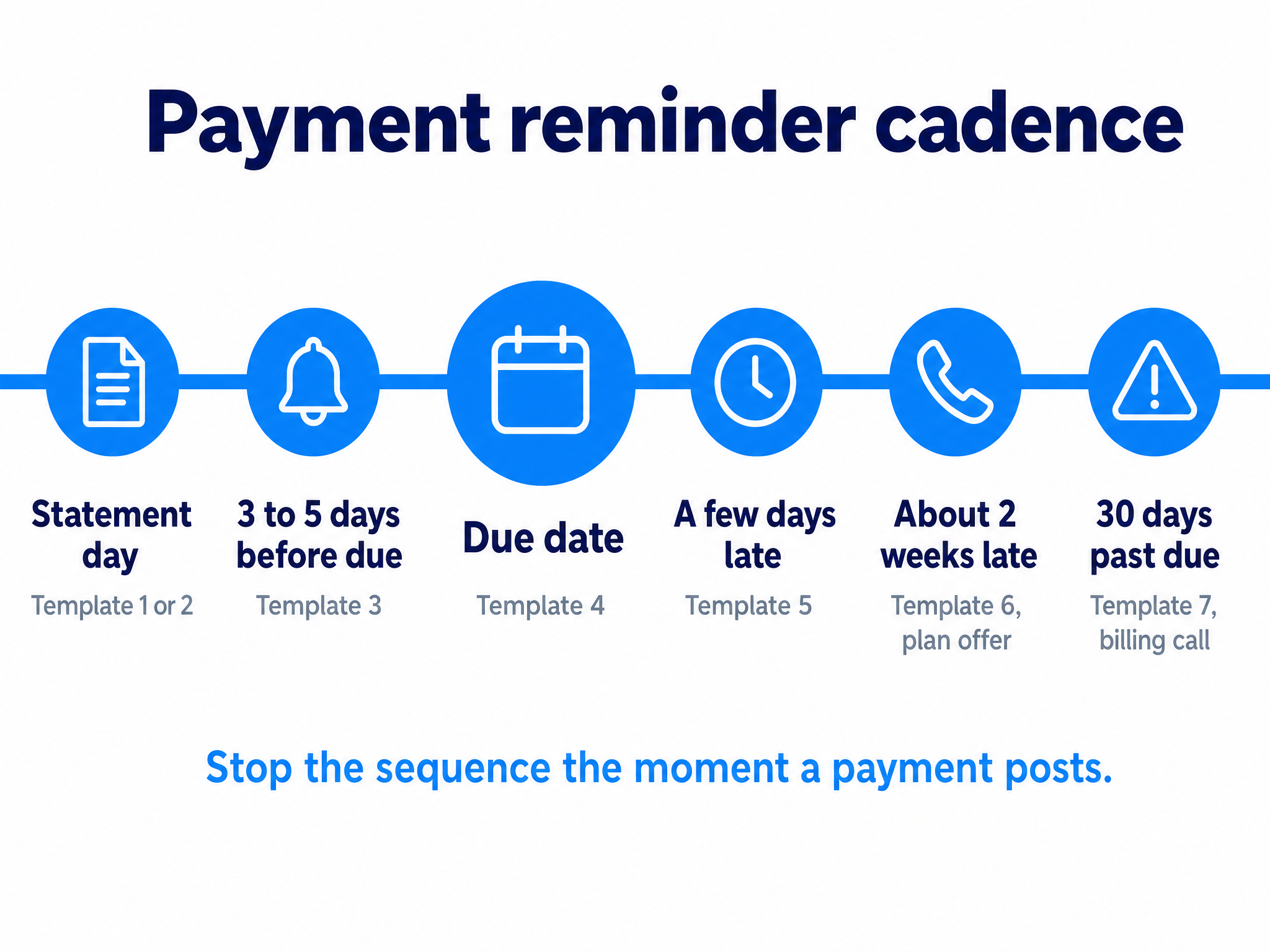
Stop the sequence the moment a payment posts. A past due text the day after someone paid sours them fast.
Offer Payment Plans Early
In Experian Health’s State of Patient Access 2026 survey of 1,013 patients, 41% of those whose payment experience improved said payment plan options helped. Among those whose experience got worse, 19% said a plan wasn’t offered. Put the plan option in your first text, not your third.
Share Estimates Before the Visit
The same survey found 48% of patients would delay or forgo care without an accurate cost estimate. Template 10 pairs the estimate with a chance to pay ahead.
Make Replies Go Somewhere
A reply of PLAN or CALL should reach a person the same business day. The principle behind two way appointment reminders applies to billing too: patients act when they can answer back. When you compare healthcare payment technology, ask whether replies reach staff, whether payments post to your practice management system automatically, and whether the payment page is PCI compliant.
Send Text to Pay Reminders with HealthTalk A.I.
HealthTalk A.I. Patient Pay sends patients a secure payment link by SMS, so they can pay from their phone with no portal login. It supports payment plan options, balance notification alerts and automated payment reminders, with real time payment posting and PCI compliant payment processing. Conversations are truly two way, and your staff see every one and can step in at any point. Outreach also adapts to each patient’s preferred language and channel.
If your statements are still sitting in mailboxes, see how text to pay works in HealthTalk A.I. Patient Pay and what it could look like in your billing cycle.
Want to see text to pay reminders running in your billing cycle?
Request a Demo