
Most patient satisfaction surveys are built backwards. Practices debate the questions for weeks, then mail the survey ten days after the visit and wonder why nobody answers. The national HCAHPS response rate now sits near 23%, meaning roughly four out of five patients never say how their care went (Flex Monitoring Team, 2025). The problem is rarely the questions. It’s timing, channel, and length. Here’s how to create a patient satisfaction survey patients will finish, with examples you can adapt today.
Key Takeaways
- About 23% of patients respond to traditional patient experience surveys, so most practices make decisions on a small, skewed sample.
- Surveys sent by text within hours of the visit outperform email and mail, and 47% of patients are most likely to give feedback within 24 hours.
- Keep it to three to five questions on one screen, in the patient’s language, with one open-ended question at the end.
- Automating the ask after every visit and routing low scores to staff in real time turns surveys into service recovery.
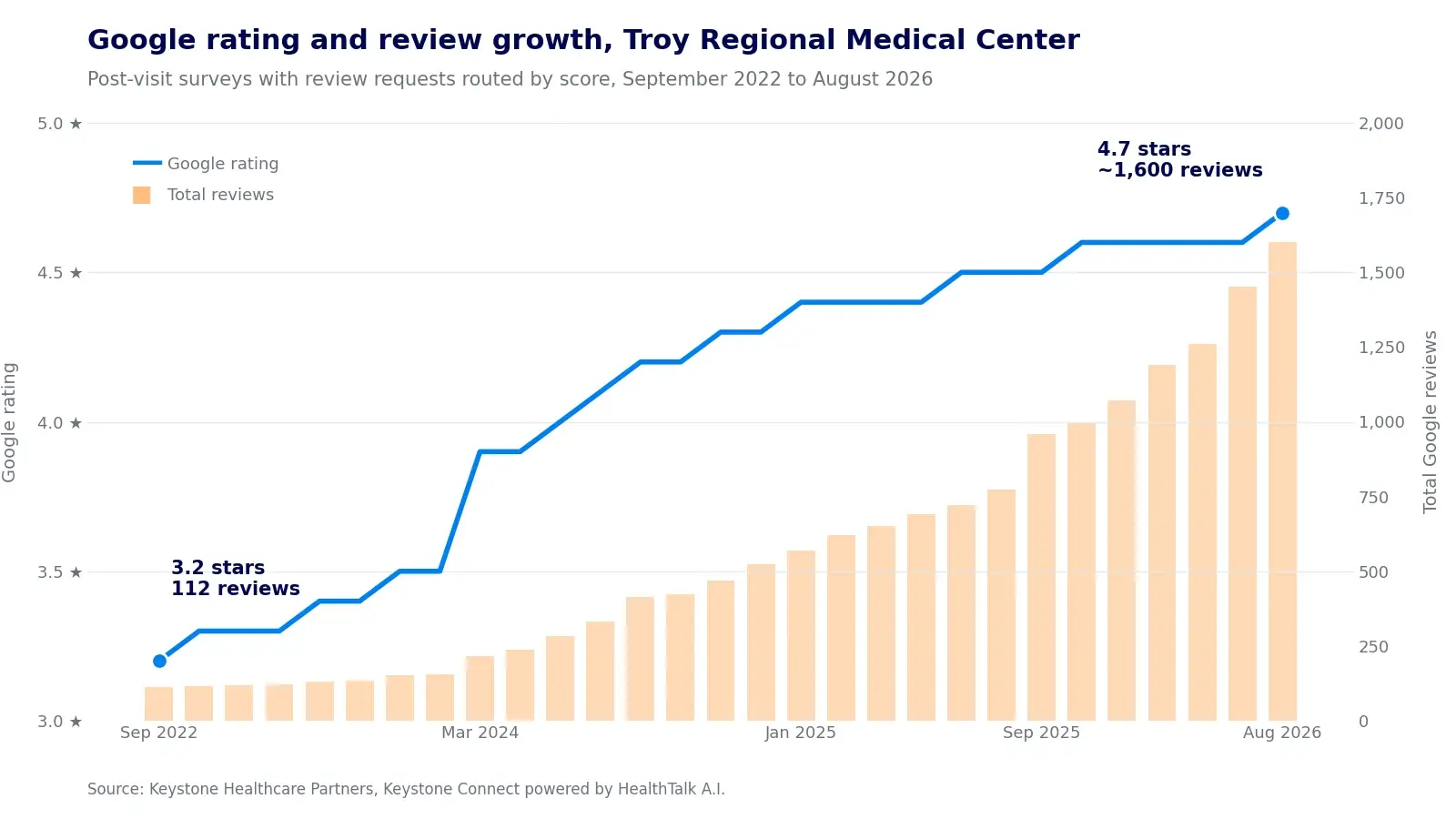
- At Troy Regional Medical Center, a survey and review loop powered by HealthTalk A.I. lifted the hospital’s Google rating from 3.2 to 4.7 stars while reviews grew from 112 to about 1,600.
Why Do Most Patient Satisfaction Surveys Go Unanswered?
Most surveys go unanswered because they arrive too late, through the wrong channel, and ask for too much. By the time a mailed survey arrives, the patient has forgotten the wait time and the front desk exchange, and an email sits behind work messages until it’s irrelevant.
Timing is the first fix. In rater8’s 2025 Patient Choice Report, 57% of patients said they rarely or never leave feedback on their own, yet 74% said they would if asked, and 47% were most likely to respond within 24 hours of the appointment (rater8, 2025).
Channel is the second. When rater8 moved practices from email to text delivery in a March 2025 study across nearly 700 client practices, response rates rose 67% relative to the email baseline, and the gain held for older patients (rater8, 2025). No surprise, given the 98% open rate for HIPAA compliant patient texting. Length is the third. Every extra screen costs completions, and the patients who quit halfway often had the most to say.
How Do You Create a Patient Satisfaction Survey Patients Will Finish?
You create one by making it short, immediate, mobile, and personal. These are the decisions that move completion rates most:
- Send it the same day, ideally within two to four hours of checkout.
- Deliver it by text. For a short three to five question survey, run it as an actual text conversation, one question per reply, so there is nothing to click. For longer surveys, send a one-tap secure link. Either way, not a portal login or PDF attachment.
- Limit it to three to five questions that fit on one phone screen.
- Ask one thing per question and keep the scale consistent (0 to 10, or 1 to 5).
- Close with one open-ended question, because that’s where the useful detail lives.
- Send it in the patient’s preferred language, since an English survey to a Spanish-speaking panel measures translation, not satisfaction. HealthTalk A.I.’s patient communication platform supports every written language.
- Name the provider and location so the message reads as personal, and say it takes 30 seconds.
Patient Satisfaction Survey Examples and Questions
The best patient satisfaction survey questions map to the moments patients remember: getting in, waiting, talking with the provider, and leaving with a plan. Two templates to copy:
Example 1: The four-question text survey (30 seconds)
- How likely are you to recommend Dr. [Name] to a friend or family member? (0 to 10)
- How easy was it to schedule and check in for your visit? (1 to 5)
- Did your provider explain things in a way you understood? (Yes / Somewhat / No)
- Is there anything we could have done better today? (Open text)
Example 2: The post-visit follow-up survey (five questions)
- How would you rate your overall experience today? (1 to 5)
- How long did you wait past your appointment time? (Under 10 minutes / 10 to 20 / 20 to 30 / Over 30)
- Did our front desk team treat you with courtesy and respect? (1 to 5)
- Did you leave with a clear understanding of your next steps? (Yes / No)
- What is one thing you would change about your visit? (Open text)
The text that opens the survey matters as much as the questions: “Hi [First name], thanks for visiting Dr. [Name] at [Practice] today. Could you answer 4 quick questions (about 30 seconds) so we can keep improving? Reply YES to start. Reply STOP to opt out.”
What Should Happen After a Patient Responds?
A response should trigger an action within minutes, not a quarterly report. A low score should alert a manager the same day so someone can call the patient before they post a one-star review or quietly move to another practice. That’s service recovery, the highest-value thing a survey can do.
High scores deserve follow-up too. Press Ganey found consumers rely on digital sources 3.1 times more than provider referrals when choosing a primary care provider, yet fewer than half have ever reviewed one online (Press Ganey). Asking satisfied patients for a Google or Healthgrades review right after a strong score closes that gap, while unhappy patients are routed to an internal channel. You can see both flows, service recovery for low scores and review requests for high ones, in this short walkthrough video.
Over time the data becomes a management tool: trend scores by provider and location, and catch a rising wait-time complaint at one site before it shows up in CAHPS results. Dr. Elizabeth James, Director of Emergency Medicine and Telehealth at Keystone, walks through how her team gathers, analyzes, and acts on patient experience data in this HealthTalk A.I. webinar. HealthTalk A.I.’s patient follow-up software automates the loop: post-visit surveys by text, real-time feedback alerts, sentiment analytics, and review requests routed by score.
Keystone Healthcare Partners runs exactly this loop at Troy Regional Medical Center’s emergency department, one of the hardest settings to survey. In July 2026, 207 ED patients responded to the post-visit survey and 88% said they would recommend the hospital. The 12% who would not became the improvement list: low scores triggered follow-up calls, and the open-ended comments pointed leadership to the two fixable issues, wait times and a lack of updates during delays. On the public side, the hospital’s Google rating has climbed from 3.2 stars across 112 reviews in 2022 to 4.7 stars across roughly 1,600 reviews today.
Make the Ask Automatic
The surveys that work are the ones nobody has to remember to send. Trigger a short text after every visit, act on low scores the same day, and turn high scores into public reviews.
See how HealthTalk A.I. automates all three.
Request a Demo