
Ask any practice administrator where operational time gets lost and scheduling comes up fast. Phone tag. Cancellations that sit unfilled. Staff time spent on hold with patients who never call back. Waitlists that don’t move because no one is actively managing them.
Traditional scheduling isn’t broken in concept. It breaks down in execution because it depends on a series of manual steps that require staff time, patient availability, and a working phone connection all coming together at once. That combination fails more often than anyone would like to admit.
AI scheduling removes the dependency on that combination. Understanding how it fits within a broader patient engagement platform is worth the context.
How Traditional Scheduling Actually Works
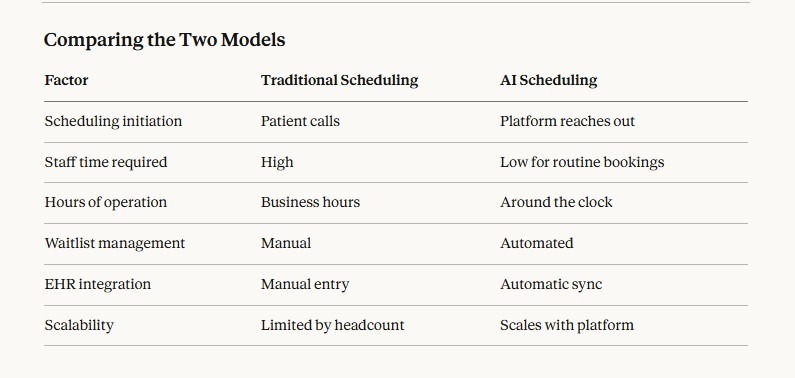
Traditional patient scheduling typically looks like this: a patient calls the practice, waits on hold, speaks with a staff member, and books an appointment that gets entered into the EHR manually. Reminders go out via automated call or text. If the patient cancels, the slot shows up as open and a staff member works through a waitlist, if one exists, to fill it.
On the outbound side, front-end staff and nurses spend significant time dialing patients to get them in for care. This requires a synchronous conversation, and most patients don’t answer. The result is voicemails, callbacks that never happen, and wasted hours. A text, by contrast, is asynchronous. It sits on a patient’s phone until they’re ready to respond and schedule on their own time.
Traditional scheduling struggles at scale. It places the burden of scheduling on either the patient or the staff, and because it’s manual, it doesn’t grow without adding headcount.
How AI Scheduling Works Differently
AI scheduling flips the model. Instead of waiting for a patient to call, the platform identifies patients who need appointments and reaches out to them directly. The patient receives a message, clicks a link, and self-schedules in real time. The appointment syncs to the EHR automatically.
No hold time. No phone tag. No staff involvement for a straightforward booking.
HealthTalk A.I. integrates AI scheduling directly with 90+ EHR systems. The platform directs patients to the appropriate provider and appointment type based on their clinical profile and provider availability, without requiring a staff member to manage the routing.
The biggest operational shift with AI scheduling isn’t just speed. It’s that the platform works continuously and asynchronously. Outreach goes out, patients respond on their own schedule, and appointments book around the clock without anyone in the office managing the process.
What Happens to the Waitlist?
This is one of the clearest examples of where AI scheduling outperforms traditional scheduling. When a patient cancels, a traditional system flags the slot as open. Filling it requires staff to work through a waitlist manually, which competes with every other task they’re managing.
AI scheduling handles this automatically. When a cancellation occurs, the platform identifies waitlisted patients, sends outreach, and books a replacement appointment without staff intervention. The slot fills faster, and the staff member who would have spent 20 minutes on phone calls spends that time on something else.
HealthTalk A.I. addresses this directly with their no-show management capability, identifying patients who need to cancel and getting them rescheduled immediately.
AI scheduling doesn’t replace the clinical judgment involved in complex scheduling decisions. It handles the routine, repeatable bookings that represent the majority of scheduling volume.
Frequently Asked Questions
Can AI scheduling integrate with any EHR?
Most purpose-built AI scheduling platforms support integrations with major EHR systems through HL7 or FHIR connections. HealthTalk A.I. integrates with 90+ EHRs, directing patients to available providers and syncing confirmed appointments back to the EHR automatically.
Does AI scheduling work for specialty practices or only primary care?
AI scheduling works across all care settings, including FQHCs, RHCs, hospitals, and specialty providers. The platform adapts its scheduling logic to the specific appointment types, provider availability, and care pathways unique to each organization.
How does AI scheduling handle patients who prefer to call?
A well-designed platform doesn’t force patients into one channel. HealthTalk A.I.’s AI Contact Center gives patients multiple ways to schedule—self-scheduling via text, web chat, or voice AI—while still accommodating those who prefer traditional phone interactions.