
Every missed call at a healthcare organization is a missed appointment, a delayed diagnosis, or a patient who gives up and goes somewhere else. For healthcare practices dealing with staffing shortages, rising call volumes, and patients who expect the same convenience they get from every other industry, the traditional call center model is breaking down.
The numbers tell the story. ScienceSoft reported in 2025 that healthcare call centers lose up to 30% of inbound calls to abandonment, with average hold times exceeding four minutes during peak hours. MGMA’s most recent staffing survey found that one in three practices cannot fully staff their front office positions. Meanwhile, patient call volume continues to climb as aging populations require more frequent care coordination.
Voice AI, sometimes called conversational AI in healthcare, is emerging as the technology that bridges this gap. Not by replacing staff, but by creating an always-available access layer that handles routine interactions so human teams can focus on the work that actually requires their judgment.
Why Healthcare Call Centers Are Failing Patients
The fundamental problem with traditional healthcare call centers is that they run on a model built for a different era. Patients can only call during business hours. Staff handle one call at a time. Every appointment, refill request, FAQ, and referral question consumes the same human resource, regardless of complexity.
This creates a predictable cascade of failures. Patients call during lunch breaks and sit on hold. They hang up. They call back the next day and sit on hold again. Some never call back at all. After-hours calls go to voicemail, and those voicemails stack up overnight into a backlog that takes half the morning to clear.
For the practice, each abandoned call represents lost revenue. A single missed appointment costs between $150 and $200 in unrealized revenue. Multiply that across dozens of daily abandoned calls and the annual impact reaches six figures for a mid-size practice. The Beryl Institute found that 96% of patient complaints are tied to service and access issues rather than clinical care, which means the phone experience is shaping patient loyalty more than the exam room.
How Voice AI Agents Actually Work
Modern AI voice agents in healthcare are not the robotic phone trees patients have learned to hate. They are conversational AI systems trained on healthcare-specific workflows that can understand natural speech, process requests, and take action in real time.
When a patient calls, the voice AI answers immediately with no hold time. It identifies the caller, understands their intent through natural language processing, and routes them through the appropriate workflow. For appointment scheduling, it checks real-time provider availability across locations and specialties, offers open slots, confirms the booking, and sends a confirmation text. For prescription refill requests, it captures the details and routes them to the pharmacy or clinical team. For common questions about office hours, insurance acceptance, or directions, it provides instant answers without consuming staff time.
The critical difference from older interactive voice response systems is that these AI voice agents handle the interaction from start to finish. They don’t just route the call to a person. They resolve it. When a request does require human involvement, the system escalates intelligently with full context so the staff member doesn’t start from scratch.
Healthcare Call Center Automation That Scales Without Adding Staff
The operational math behind healthcare call center automation is compelling. A single front desk employee can handle roughly 40 to 60 calls per day. A voice AI system can handle thousands of concurrent interactions with no degradation in quality or speed.
This isn’t theoretical. Organizations deploying conversational AI for inbound access are reporting measurable results across several categories.
Abandoned call rates drop significantly when every call is answered on the first ring, 24 hours a day. Scheduling conversion improves because patients can book in the moment rather than calling back later or not calling back at all. Staff utilization shifts from repetitive phone work to higher-value tasks like clinical coordination, insurance follow-up, and complex patient needs.
The after-hours impact is particularly significant. Research from the Medical Group Management Association shows that up to 35% of patient calls come outside standard business hours. Without voice AI, those calls go to voicemail or an answering service that takes messages but can’t schedule appointments or resolve requests. With a healthcare voice assistant handling after-hours traffic, organizations capture demand that previously disappeared overnight.
Patient Access Automation Beyond the Phone Call
Voice AI’s impact extends beyond simply answering inbound calls. When integrated with a practice’s EHR and scheduling systems, it becomes a patient access automation engine that connects demand to care delivery across multiple touchpoints.
Patients who cancel appointments trigger automated waitlist outreach to fill the slot before revenue is lost. Overdue care gap patients receive proactive voice outreach in their preferred language, with the ability to schedule directly during the call. Post-visit follow-up calls check on patients, capture satisfaction data, and schedule needed follow-ups without staff involvement.
This shifts the access model from reactive to proactive. Instead of waiting for patients to call and hoping staff can handle the volume, organizations reach out at scale and convert more demand into scheduled visits.
The Agentic AI Shift: From Automation to Action
The next evolution of voice AI in healthcare goes beyond scripted automation into what the industry is calling agentic AI. These systems don’t just follow pre-built decision trees. They understand intent, evaluate context, and take autonomous action within defined clinical and operational guardrails.
An agentic voice AI can recognize that a patient asking about a sore throat also has an overdue annual wellness visit and offer to schedule both. It can detect urgency in a caller’s tone and escalate appropriately. It can adjust its approach based on previous interactions with the same patient, creating a personalized experience that rigid IVR systems could never deliver.
This represents a shift from call handling to access orchestration: demand comes in, the AI engages, and access is delivered.
What This Means for Healthcare Leaders
Healthcare organizations evaluating voice AI should look beyond the technology itself and focus on the operational outcomes it enables. The practices and health systems gaining the most ground are the ones measuring impact in terms of scheduled visits recovered, staff hours redirected, after-hours conversion rates, and patient satisfaction scores rather than calls answered.
The old access model was built around how many people you could put on the phones. Voice AI changes the equation entirely. It creates continuous, scalable access that operates at the speed patients expect without the staffing constraints that have held healthcare back.
The goal isn’t answering more calls. It’s converting every patient request into care.
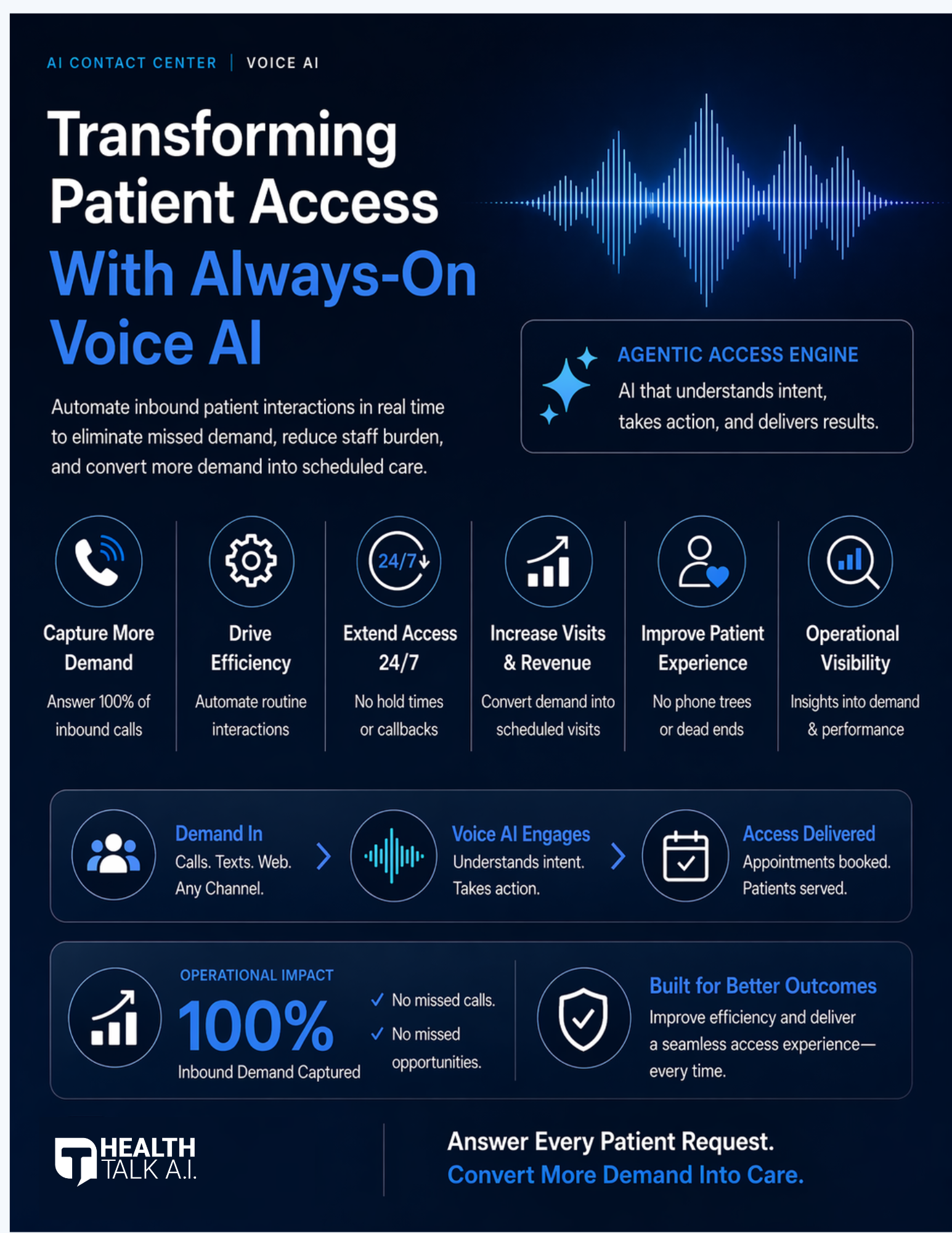
See how HealthTalk A.I. Voice AI helps organizations expand access without expanding staff.
Request a DemoFrequently Asked Questions
What is conversational AI in healthcare?
Conversational AI in healthcare refers to AI-powered voice and chat systems that understand natural language and complete patient interactions end-to-end, such as scheduling appointments, answering FAQs, processing refill requests, and routing complex needs to staff. Unlike older IVR phone trees, conversational AI resolves requests rather than just routing them.
How is voice AI different from a traditional IVR or phone tree?
Traditional IVR systems force patients through rigid menu options and usually end with a transfer to a live agent. Voice AI uses natural language understanding to handle the full conversation, take action in real time, and only escalate to staff when human judgment is required, with full context attached.
Will voice AI replace front desk staff?
No. Voice AI handles the high-volume, repetitive interactions that consume most front desk time, such as appointment booking, refill requests, and routine questions. This frees staff to focus on complex patient needs, insurance coordination, and clinical follow-up that require human judgment.
Can voice AI integrate with our EHR and scheduling system?
Yes. HealthTalk A.I. integrates with 90+ EHR systems and connects directly to provider schedules, allowing the voice AI to check real-time availability, book appointments, capture refill requests, and sync data back to the EHR automatically.
How does voice AI handle after-hours calls?
Voice AI answers every call immediately, 24/7, including evenings, weekends, and holidays. With up to 35% of patient calls coming outside business hours, this captures demand that would otherwise go to voicemail or be lost entirely.